Monday, November 23, 2009

The sleep cycle


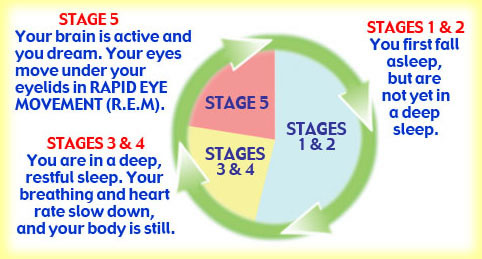
The sleep cycle is known to repeat itself four to five times during an average persons single nights sleep, but has been know to repeat itself up to seven times. You can certainly see how it is possible for one person to have several different dreams in one night.

Most people only ever really remember the last dream they have; the one that occurs closer to the morning, before they wake up. Just because you do not remember those earlier dreams in the sleep cycle does not mean they never happened, it is just a case that you don’t remember them.

1. Stage one is characterised by NREM or non rapid eye movement. It is fundamentally the stage in which you are entering light sleep. Your muscles become relaxed, your heart rate becomes slower and your body temperature drops.
2. Stage two is also characterised by the NREM, but there is a further drop in body temperature and the muscle relaxation deepens. This is when the body’s immune system begins it’s task of repairing the body. In this stage, you are completely asleep.
3. Stage three sees that you are still within the NREM stage, but the sleep you are experiencing is very deep, with your metabolic levels being very slow.
4. Stage four is the point when the most vivid dreams occur. You move into the REM stage, where your eyes are erratically moving. Your heart rate rises along with blood pressure and your breathing may become irregular as your brain activity increases. If you are to wake during this stage of the sleep cycle, then this is where you are most likely to remember your dreams accurately.

Reference: http://dreamology.wordpress.com/2009/01/29/the-sleep-cycle/

History of dreams


Dream interpretations dates back to 3000-4000 B.C. were they were documented in clay tablets. It is said that people in primal societies were unable to distinguish between the dream world and reality. They not only saw the dream world as an extension of reality, but the dream realm was a more powerful world.

Back in the Greek and Roman era, dream interpreters accompanied military leaders into battle. Dreams were extremely significant and often seen as messages from the gods. They were seen in a religious context and in Egypt, priests also acted as dream interpreters. The Egyptians recorded their dreams in hieroglyphics.

People with particular vivid and significant dreams were believed to be blessed and were considered special. People who had the power to interpret dreams were looked up to and seen as divinely gifted. In the bible, there are over seven hundred mentions of dreams. Tracing back to these ancient cultures, people had always had an inclination to interpret dreams.

Dreams were also seen as prophetic. People often looked to their dreams for signs of warning and advice. It was an oracle or omen from outside spirits, whether it was a message from a deity, from the dead or even the works of a demon. Dreams often dictated the actions of political and military leaders and aided in diagnosis for the medicine men. Dreams was a vital clue for healers in what was wrong with the dreamer and used them to make a diagnosis. People in ancient Greece and ancient China looked to their dreams for their next course of action.

Dreaming can be seen as an actual place that your spirit and soul leaves every night to go and visit. The Chinese believed that the soul leaves the body to go into this world. However, if they should be suddenly awakened, their soul may fail to return to the body. For this reason, some Chinese today, are wary of alarm clocks. Some Native American tribes and Mexican civilizations share this same notion of a distinct dream dimension. They believed that their ancestors lived in their dreams and take on non-human forms like plants. They see that dreams as a way of visiting and having contact with their ancestors.

Dreams also helped to point their mission or role in life. In the early 19th century, dreams were dismissed as stemming from anxiety, a household noise or even indigestion. Hence there was really no meaning to it. Later on in the 19th century, Sigmund Freud revived the importance of dreams and its significance and need for interpretation. He revolutionized the study of dreams.

Reference: http://bahcecikdevekusu.com/dreamcenter/history.htm

What causes dreams?

Dreams serve a purpose. They serve a specific function for our bodies and mind. While many dream analysts at the turn of the century focused on dream interpretations, dream experts of today focus on the scientific approach of what causes dreams. Dream Analyst and author Craig Webb says before we can look at what causes dreams, we must understand what dreams are to begin with. “Usually we define a dream as an experience remembered upon awakening that comes through nonphysical channels. Basically, it is an altered experience we have when we are sleeping and that we remember when we wake. However, there are lots of other variations on the definition. Some people define dreams as life goals and wishes for the future. This is another way we use the word.

According to the Freudian school, dreams are the result of subconscious thoughts and desires. The other extreme attributes dreams to random "noise" in the neurons without special meaning.
There is definitely value behind dreams nevertheless; nobody knows precisely, that causes them. The general theory - which they occur from subconscious thoughts from our daily thoughts and actions. It is true, things which we underline about the majority; apparently, take a priority in our dreams, though not always.

Reference: http://www.types-of-dreams.net/what-causes-dreams.html

Dream & Oneirology


What is dream?

- a succession of images, thoughts, or emotions passing through the mind during sleep.
- the sleeping state in which this occurs.
- an object seen in a dream.

Reference:
http://dictionary.reference.com

Oneirology
The term oneirology refers to the systematic study of dreams within a scientific framework. As such it must be distinguished from oneiromancy which refers to using dreams for divinatory purposes. Both words come from the Greek oneiro - "dream".
The birth of oneirology as a discipline is often dated to the 1950s and the discovery by Kleitman and Aserinsky of the sleep cycle and the subsequent discovery of REM sleep. However the term itself goes back much further - Freud himself used it in his classic The Interpretation of Dreams.

Reference: http://www.here-be-dreams.com/dreams/oneirology.html

Critical commentaries on social behavior in Malaysia


To dream a dream

Most Malaysians do not have dreams. They are either not ambitious enough or they are fear to dream because they are fear of failure. On the contrary, those who have dreams do not take their dreams seriously. They give up their dreams without trying their best when they face any obstacles.

Those who have dreams never really take the initiative to fulfill it. They give up before they put in their best efforts to make their dreams come true. They should be more persistent. Some are not confident with their own abilities or they feel insecure, therefore, they hold back their dreams. This is why there are so many jobless people in Malaysia. Once they face failure, they were scared to stand up again. They were scared of embarrassment and the way society might think of them or they think it is impossible to achieve because it is too difficult.


Dreams are important because it gives us something to aim for and it helps to improve ourselves. It inspires us and gives us motivation to do something out of our expectations.


follow your dreams...

How to achieve your dreams? To achieve a dream is not easy. If it is easy, achieving them would not make them worthwhile. Nevertheless, we should aim high and think big.
The first step is to set a goal for ourselves. Then, discover our passion and starts to dream. We should believe in our abilities and do not quit when it gets hard. Struggle and work really hard, believing that it is possible to achieve these dreams. If you have the passion to go the distance, then you are closer than you think.

These are blogs created for Malaysians to think of a dream or a desire they have for Malaysia to produce a better generation for the nation.
http://we-are-malaysians.blogspot.com/
http://www.dream.net.my/country/main.php

Give your dreams a chance --------> http://blog.thestar.com.my/permalink.asp?id=7956

How is this issue addressed in my project?
It is all about dreams. I would like the audiences to learn more about dreams and the importance of dreams. We succeed because we believe in ourselves, we believe in dreams. Everything is possible. If you can dream, you can do it!

Thursday, November 19, 2009

An interactive installation of 'Dreams'

The Death of Dreams (Interactive Installation) from AWESOME ▲ MOUNTAIN on Vimeo.

Final Proposal

Topic: Dreamspace


Background:

Dreams are images, thoughts, sounds, or emotions that pass through our mind when we sleep. Everyone dreams. It is just a matter of whether we remember it or not. Everyone’s dream is unique as it is connected with our own reality-background and experiences. Study shows that dreams help you to tackle stress. Dreaming is a necessity as it helps to recharge mind and revitalize your body.

Some individuals believe that dreams can see into the future. There is no scientific proof yet that dreams may predict our future but there are many cases where people dreams and it eventually came true.

Type of dreams:
- daydreams
- false awakening dreams
- lucid dreams
- nightmares
- recurring dreams
- healing dreams
- prophetic dreams
- signal dreams
- epic dreams

Example of common dreams:
- Teeth Dreams
- Chase Dreams
- Falling Dreams
- Flying Dreams
- Naked Dreams
- Test Dreams

Dream Theorists:
- Alfred Adler
- Sigmund Freud
- Carl Jung
- Frederick Perls

Problem Identification:
We dream every night whether we remember it or not but we seldom recall our dreams and we have never thought of the purpose of our dreams.

Aim & Objective:
- to show that dreams are connected with our reality, what we face in reality will affect the content of our dreams.
- to explore dreams
- to have fun with dreams.

Ideation & Concept:
5 objects (with sensor) will be placed in a dark area, with a screen in front. Each object will represent a type of dream. When user touch on the objects, different visuals will show on screen. A combination of more than 1 object will create different effects on screen. When the object is shaken, the visual will turn blur.

- the screen represent our brain
- visuals on the screen represent our memories.
- the object is the reality
- when we sleep, these object interact with our memories to create a new world; dream.
- what we face/do in the reality will affect our dreams.

In lucid dream, we are able to control our own dreams and manipulate the imaginary experiences in the dream environment.


Motivation:

I dream every night whether it is something odd, strangers which I have never met before or repeated dreams and I have always been wondering the meaning of these dreams, the reason of my dreams.

"Dreams are the touchstones of our characters." - Henry David Thoreau


References:
http://www.dreammoods.com/dreaminformation/dreamtypes/
http://www.dreamviews.com/
http://dreamemporium.com/why_we_dream.html